
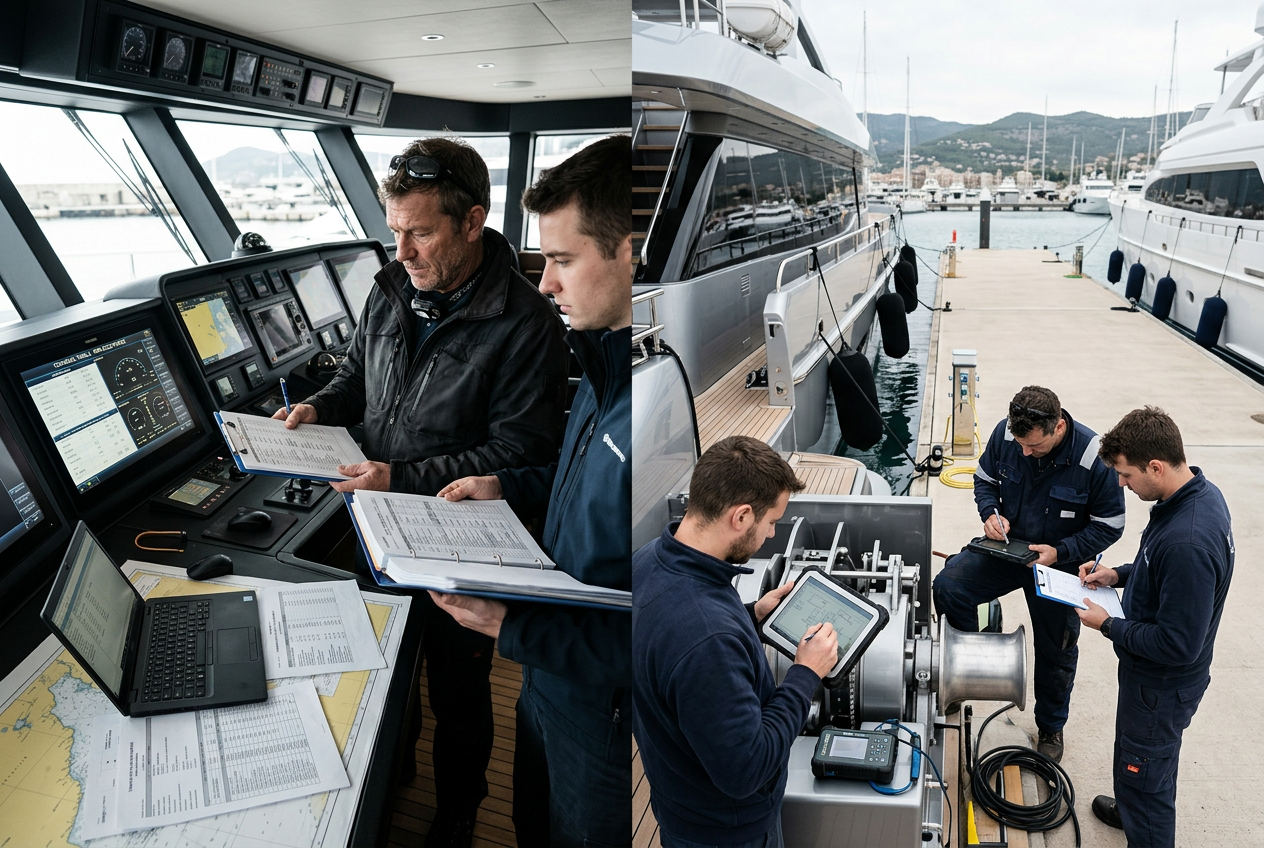
Sea trials are often treated as the moment when the yacht finally proves itself. That is only partly true. By the time a yacht goes to sea, most of the real project outcome has already been shaped by earlier decisions: what was installed, how it was commissioned, what still remains open, which approvals are complete, what is actually being demonstrated, and how the results will be judged. If acceptance planning is weak, sea trials turn into a rushed mixture of testing, negotiation, defect logging, and guesswork. If acceptance planning is solid, sea trials become a controlled confirmation stage rather than a public discovery session.
That distinction matters because sea trials are not simply a sea-going checklist. Official guidance on trial approval notes that sea trials are essential for demonstrating satisfactory performance of machinery, equipment, and safety systems before final certification. Classification guidance also makes clear that trial activity sits within a wider survey and verification process, not outside it. In other words, trials are part of acceptance, not a substitute for acceptance planning.
Start with a clear statement of what is being accepted
The first job is to define the acceptance scope. That sounds obvious, but it is where many trial problems begin. A yacht may be going to sea to prove propulsion performance, steering response, automation functions, alarms, navigation interfaces, hotel loads, vibration behaviour, or a package of modifications completed during a refit. Those are not the same exercise, and they should not all be judged by vague language such as “working satisfactorily.”
Acceptance planning should identify each system or function being demonstrated, the expected result, the evidence required, and the party responsible for witnessing, recording, and signing it off. Without that structure, the sea trial becomes an event where different people arrive with different assumptions about what success means.
Dock trials and harbour testing should already have done part of the work
Sea trials should not be the first time major systems are seriously exercised. Classification guidance commonly expects propulsion and machinery operation to be demonstrated in a dock trial before sea trials, with specified measurements and functions checked in the presence of a surveyor where required. That sequence matters because sea time is expensive, weather-dependent, and operationally exposed. Problems that can be found safely alongside should be found there.
In practical terms, acceptance planning before sea trials should clearly separate:
- what must be proven alongside first,
- what can only be verified underway,
- what depends on weather or load condition,
- and what still remains conditional even after a successful trial.
That prevents a common failure pattern: taking unresolved commissioning issues to sea and then trying to interpret incomplete results as if they were final acceptance evidence.
Test conditions need to be defined before anyone boards the yacht
A trial result is only meaningful if the conditions are understood. Speed, propulsion response, load condition, weather, water depth, trim, tank state, enabled systems, and instrument setup can all affect what the yacht appears to be doing. Some technical rules explicitly define reference conditions for measured performance during sea trials. That is a reminder that “the yacht looked fine” is not an acceptance method.
So acceptance planning should state:
- the target conditions for each test,
- acceptable tolerances,
- any limitations on interpretation,
- and what will happen if conditions are outside the agreed range.
This matters most when the trial includes performance-sensitive items such as speed, vibration, manoeuvring, dynamic response, power generation, or integrated system behaviour. If the conditions are not controlled or at least recorded properly, the result can become arguable later.
Roles, witness points, and decision authority should be fixed in advance
Sea trials often bring many parties together at once: yard personnel, subcontractors, crew, owner’s representatives, technical managers, class surveyors, flag-side attendees where relevant, and specialist technicians. That only works if responsibility is clear. Guidance on testing during new-building and repair periods stresses hazard identification, risk assessment, and defined mitigation controls during shipboard and factory acceptance testing because these periods combine technical activity with high operational stress.
Before the yacht leaves the berth, the plan should define:
- who runs the trial,
- who can stop a test,
- who records results,
- who logs deficiencies,
- who decides whether a failed item is retried, deferred, or accepted with condition,
- and who signs the official record.
If that authority structure is unclear, even a technically successful trial can produce a weak acceptance outcome because nobody is certain which observations are formal, which are informal, and which are still open.
Safety planning is part of acceptance planning
This point is often underrated. A yacht on trial is not simply “finished and going for a run.” It may still contain recent modifications, temporary arrangements, incomplete close-outs, exposed interfaces, or recently energised equipment. Industry safety guidance for shipyard and acceptance-testing environments specifically warns that introducing a ship or new equipment into service after construction or repair is a period of intense activity with serious incident potential.
So the acceptance plan should include:
- a trial-specific risk review,
- emergency communications,
- equipment isolation and restoration procedures,
- passenger and attendance limits,
- permit or authorization controls for hazardous testing,
- and clear boundaries around what is not yet accepted for unrestricted use.
Sea trials are a technical event, but they are also an operational-risk event. Treating them as only a performance exercise is poor preparation.
The defect and punch-list process should already be built into the plan
Sea trials almost always generate findings. That is normal. The real issue is how those findings are classified and handled. Acceptance planning should define the difference between:
- a critical failure,
- a non-conformity,
- a minor defect,
- an observation,
- a setting adjustment,
- and an item that can be deferred without compromising delivery.
It should also define how retests are handled and what evidence closes the item. Some technical rules require the results of sea-trial testing to be submitted formally in writing. That is a useful benchmark: if the result matters enough to support survey, certification, or acceptance, it should matter enough to be recorded properly.
Without that structure, the same sea-trial issue can be described three different ways by three different people, and the project ends up arguing about language instead of solving the defect.
Documentation should be prepared before the trial, not after it
A strong acceptance plan includes the paperwork package before the yacht leaves. That means approved test sheets, attendance lists, sign-off routes, deficiency logs, calibration or measurement references where needed, and a place to record deviations from the plan. Sea trials should generate evidence into a prepared structure, not force the team to reconstruct events later from notes and memory.
This is especially important where sea-trial results support later class, statutory, warranty, or delivery-stage decisions. If a result is going to be relied on later, it should be recorded in a form that survives turnover, management change, and post-delivery disputes.
A good sea trial plan reduces surprises before the yacht leaves the dock
The practical test is simple. Before sea trials begin, the team should already know:
- what is being demonstrated,
- under what conditions,
- to what criteria,
- with which witnesses,
- under which safety controls,
- using which documents,
- and how any failure will be treated.
If those answers are still loose, the trial is being asked to do too much. Sea trials should confirm readiness, not define it. The better the acceptance planning is before the yacht goes to sea, the more useful the trial becomes as evidence rather than drama.
