
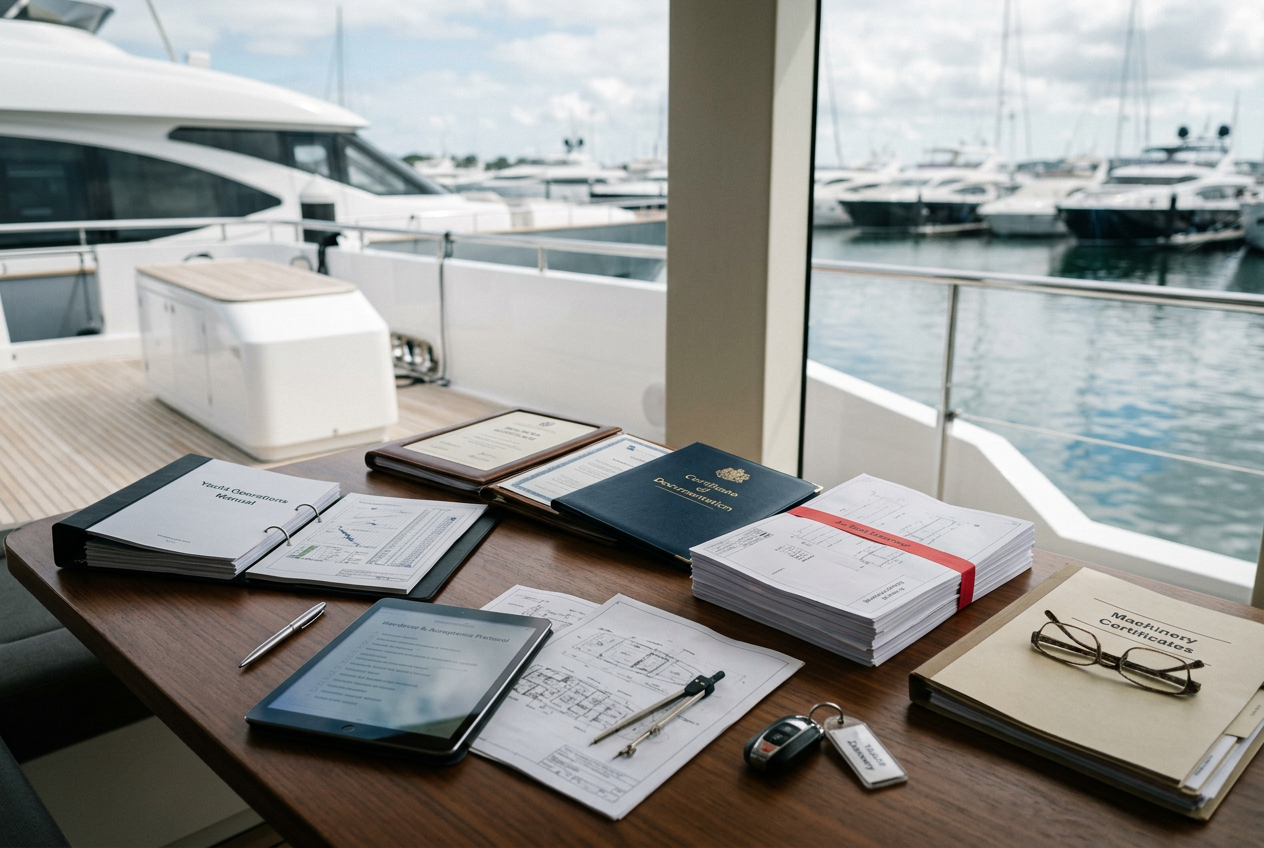
A yacht handover package is often treated as a box-ticking exercise at the end of a build or refit. That is a mistake. If the documentation is incomplete, disorganised, or still dependent on verbal explanations from the yard, the yacht may look finished while still being difficult to operate, difficult to maintain, and difficult to defend during inspections, warranty claims, resale, or later refit planning. Market-facing project-management pages also treat delivery, sea trials, final acceptance, and warranty management as one continuous phase rather than separate tasks.
The first point to understand is that there is no single universal handover checklist for every yacht. The required certificate set and part of the onboard document set depend on the yacht’s flag, tonnage, operating profile, and whether it falls under specific code or convention thresholds. GOV.UK’s vessel certification guide states that the certificates a UK-registered vessel must carry vary according to vessel type, gross tonnage, cargo profile, and voyage type. The UK large-yacht guidance also makes clear that manning and certification requirements are tied to the vessel’s operational status.
The certificate file comes first
The most obvious part of a handover package is the certificate set, but even this is often underestimated. For large commercial yachts under the LY3 framework, the initial survey certification list can include an International Load Line Certificate, Certificate of Compliance, Cargo Ship Safety Construction Certificate, Cargo Ship Safety Equipment Certificate, Cargo Ship Safety Radio Certificate, International Oil Pollution Prevention Certificate, International Tonnage Certificate, Safe Manning Document, Safety Management Certificate, International Ship Security Certificate, International Sewage Pollution Prevention Certificate, International Air Pollution Prevention Certificate or EIAPP, Anti-Fouling documentation, and Maritime Labour certification where applicable. GOV.UK’s vessel-certification guide gives a similar outline for UK-registered vessels.
That does not mean every yacht should receive every document on that list. It means the handover file should contain the full certificate set that applies to that yacht, in its final valid form, with expiry and survey cycles clearly understood. IMO’s facilitation guidance explicitly references the official list of certificates and documents required to be carried on board ships, which is a reminder that “documentation” is not a soft project-management concern. It is part of the vessel’s compliance state.
The handover file should also show the technical basis of the finished yacht
A proper handover is not only a stack of certificates. It should also include the technical record of what was actually delivered. In practice, that means final approved specifications, drawing sets relevant to the delivered configuration, equipment schedules, vendor data, revision-controlled change records, and any important approval correspondence that explains why a system, layout, or item differs from earlier versions. Fraser’s project-management material stresses how much depends on specifications and drawings being technically solid from the start, while Praxis describes ongoing review of submittals, shop drawings, compliance with contracted specifications, and technical validation through construction and acceptance. That same logic applies at handover: the owner should receive a final technical baseline, not only a finished-looking yacht.
This is where “as-built” thinking matters, even if the project never labels the folder that way. The handover package should let a future captain, engineer, manager, or surveyor answer basic questions quickly: what was installed, to which revision, under which approval path, with which settings, limitations, and supporting documents. If that answer still depends on memory, WhatsApp messages, or old issue lists from the yard, the handover is not complete in any meaningful operational sense. That is an inference from how project managers and owner’s representatives handle specifications, approvals, commissioning, and delivery, but it is the practical consequence of those responsibilities.
Manuals and onboard instructions belong in the delivery set
A finished yacht also needs a usable operating and maintenance document set. LY3 explicitly refers to required onboard manuals and instructions in several areas. The code references a training manual for lifesaving appliances, onboard maintenance instructions, survival-craft and equipment operating instructions, and, for yachts over 500 GT, a fire training manual required by SOLAS II-2/15. In addition, LY3 includes examples where maintenance manuals and planned maintenance schedules are tied to survey and review of maintenance history.
That matters because a handover package is supposed to support operation after the yard period, not only prove that the project happened. If the chief engineer or captain receives certificates but not workable manuals, maintenance instructions, spare-part references, software or control-system documentation, and service intervals, then the yacht may enter service already carrying avoidable technical risk. GOV.UK’s domestic safety-management guidance, although written for a different operating context, is useful here because it shows the kind of records auditors expect operators to maintain: training manuals, crew qualifications, drill records, maintenance records, repair records, and certification related to equipment and safety systems. The underlying lesson is broader than that code alone: documentation has to support safe operation, not just formal turnover.
Test records and acceptance records should be in the file, not in email chains
One of the most common weaknesses in yacht handovers is poor capture of commissioning and acceptance evidence. Praxis describes commissioning and acceptance as a phase where systems are verified through dock trials and sea trials, deficiencies are documented, final inspections are coordinated, and formal acceptance is managed. Fraser’s project-management material also places sea-trial supervision, completion, outfitting, delivery, delivery management, and warranty management within the same support scope.
That means the handover package should include the final test and acceptance record, not merely the statement that testing took place. A strong delivery set usually contains signed trial reports, deficiency records, close-out status, commissioning results, calibration or setup records where relevant, and evidence of what remains open at acceptance. If there are exceptions, temporary measures, deferred works, or owner-supplied items still under completion, those should be visible in a formal outstanding-items register. Otherwise the line between “accepted” and “unfinished” becomes blurry very quickly. This point follows directly from how commissioning, deficiency tracking, and formal acceptance are described in project-management practice.
Manning, crew, and statutory operating documents should not be left outside the package
A yacht may be technically complete and still not be administratively ready to operate. The UK large-yacht guide states that commercially operated large yachts on the UK register must have a Safe Manning Document issued by the MCA, and it explains the need for Certificates of Equivalent Competency where applicable, together with related evidence kept on board during processing. It also details watch-rating and certification expectations for crew.
So the handover file should clearly separate the vessel’s own certificates from the operating document set that supports legal and practical readiness: safe-manning documents, relevant crew-certification records or status tracking, training records where required, and any onboard compliance folders needed for inspections or port-state review. This is one of the easiest areas to leave half-finished when the project team focuses too heavily on technical completion and not enough on the yacht’s first weeks of real operation.
Warranty, defects, and service follow-up should be documented from day one
A handover file is also where the warranty period really starts to become manageable. Praxis states that support beyond delivery includes warranty documentation tracking, prompt issue reporting within claim windows, coordination of remedial actions, and verification of corrections. Fraser likewise places warranty management inside the normal project-management scope, not outside it.
That means the delivery package should include vendor and yard warranty terms, warranty start dates, claim routes, equipment-specific coverage, unresolved punch-list items, and a clear record of what was corrected before delivery versus what remains under monitoring after delivery. Without that structure, routine post-delivery defects often become argument rather than administration. The yard says the issue was not reported correctly, the owner’s side cannot show the relevant acceptance record, and the crew inherits a problem that should have been easy to track.
The useful test is simple
A good yacht handover package should let a new captain, engineer, manager, surveyor, or future refit team answer five practical questions quickly: what was delivered, what standards and approvals support it, how it should be operated, how it should be maintained, and what remains open after delivery. If the file cannot do that, it is not complete, even if the folders look impressive. The point of handover documentation is not administrative decoration. It is continuity between project completion and real-world yacht operation.
